If you are reading this on a blog or website other than Cindy’s Love Of Books or via a feedreader, this content has been stolen and used without permission.
Month: October 2011
I am guesting posting today…
Today I am honored to be guest posting at Moonlight Gleam’s Bookshelf for her and Paper Cut Reviews Feast of Screams event.
I have only met Lucy from Moonlight Gleam’s Bookshelf recently and I consider her a dear friend so I was truly honored when she allowed me to do this for her. So if you haven’t checked out her blog yet you really should and the same with Paper Cuts.
Happy Halloween Everyone.
If you are reading this on a blog or website other than Cindy’s Love Of Books or via a feedreader, this content has been stolen and used without permission.
(Guest Post) Author Robert Orfali
Pages: 254
About the Book:
In Death with Dignity, Robert Orfali makes a compelling case for legalized physician-assisted dying. Using the latest data from Oregon and the Netherlands, he puts a fresh new slant on perennial debate topics such as “slippery slopes,” “the integrity of medicine,” and “sanctity of life.” His engaging writing style brings clarity to these issues. The content is thought-provoking; the arguments are well-researched, air-tight, and original.This extraordinary book provides an in-depth look at how we die in America today. It examines the shortcomings of our end-of-life system. You’ll learn about terminal torture in hospital ICUs and about the alternatives: hospice and palliative care. With laser-sharp focus, Orfali scrutinizes the good, the bad, and the ugly. He provides an insightful critique of the practice of palliative sedation. The book makes a strong case that assisted dying complements hospice. By providing both, Oregon now has the best palliative-care system in America. Reading this book, above all, may help you or someone you care about navigate this strange landscape we call “end of life.” It can be your gentle and informed guide to “a good death” in the age of hospice and high-tech medical intervention.
About the Author:
Robert Orfali, the guru of client/server systems in the early days of Silicon Valley, co-authored three best-selling books that demystified the complexity of these mission-critical systems and made them understandable to a whole new generation of programmers. The books sold over a million copies. In this book, Death With Dignity: The Case for Legalizing Physician-Assisted Dying and Euthanasia, Robert uses his analytical skills to deconstruct the most complex system he has yet encountered: our modern end-of-life system. He wrote this book after helping his soulmate and coauthor, Jeri, navigate her death from ovarian cancer in 2009. The deep emotions Robert felt allowed him to look at how we die from a different perspective, another angle. Robert also wrote Grieving a Soulmate.
Q: Most people don’t want to die and don’t plan for it. Most people won’t even have entertained the idea of a DNR (do not resuscitate) order in case their heart stops beating. It is a natural instinct for people to want to fight harder to live, and physicians have taken the oath to save lives. When medical care offers all these life-prolonging treatments, at what point would someone introduce a conversation with their doctor that they want to die?
RO: You are so right. Most of us prefer to avoid the topic of death. We live in a death-denying culture. However, denial can have some serious ramifications. Closing our eyes and letting the system follow its course could easily land us intubated in an ICU at the end of our lives. To prevent this outcome, we need to protect ourselves and understand our choices. And, we need to think about it while we still can. Typically, it means having several conversations about death and dying. This is especially important for the chronically ill. It could make the difference between having a relatively “good death” and a very “bad death.” The sad fact is that dying in the age of chronic disease is an extremely complicated process that involves a lot of anguish, pain, and suffering akin to torture. The lucky few will go suddenly. But the remaining 80% will not leave life the way they would have liked to: “at home and without needless suffering.”
Ironically, some politicians called these conversations death panels, and they campaigned against having them funded by Medicare. It seems that they do not want us to have any control over how we die. It seems that even discussing the topic is taboo. Most doctors would also prefer not to discuss the topic. Why? It’s very emotional and complicated. To do it justice would require hours of discussions with the patient. Doctors are trained to heal, not to discuss death. They are taught to fight the disease with everything in their arsenal; there is no surrender. So they would rather initiate another treatment than deal with the existential issues of dying. Continuing the treatments also protects doctors against malpractice lawsuits.
Even though insurance does not pay for these consultations, we must have these discussions to understand what our options are. In my book, I tell you about three death-related conversations you must initiate over a period of time: How do I protect myself? When do I stop fighting? Where will I die? In states where physician-assisted dying is legal, you can have one more conversation: How will I die?
The first conversation is straightforward and practical: it’s about writing an advance directive and choosing your health-care proxy. The next two are blurrier; in the book I use my wife Jeri’s conversations to demonstrate the issues. The bottom line is that we have two health-care systems in America today: modern medicine and hospice. (Palliative care is mostly associated with hospice, but it also has pockets within the medical system.) In the age of slow dying and chronic illnesses, we need both systems. The ICU works well for us, most of the time. It does what it was designed to do: it is a superb illness-fighting machine. Hospice is also a superb system; it provides outstanding end-of-life care for the dying (except for terminal sedation and hence the need for assisted dying, as allowed in Oregon). So, we are lucky to have two systems that work: each one superb in the function it was designed to perform. In the book I make the case that assisted dying complements hospice. By providing both, Oregon has the best palliative care system in America.
So what’s the problem? The problem is that we live in a death-denying culture that makes it very hard to transition from one system to the next when the right time arrives. We, and our doctors, have a very hard time accepting death. Consequently, most of us won’t make the transition in time. We will end up dying in the ICU—a modern torture chamber for the dying. As Dr. George Lundberg describes it: “A sophisticated hospital is the last place you want to be when terminally ill. Once you’re in the hospital setting, you’re trapped. The staff owns you, and they will do those terrible things they have been trained to do to prolong life, no matter how artificially or hopelessly.”
Ironically, moving to hospice sooner may prolong our lives. In a recent study, the mean survival was 29 days longer for hospice patients than similar patients who did not choose hospice. In another study, patients with terminal lung cancer who began receiving palliative care immediately upon diagnosis not only were happier, more mobile, and in less pain as the end neared, but they also lived nearly three months longer.
The ICU was never designed to help us die; it was designed to fight disease to the end. We want our illness-fighting machine to continue doing what it does best. Instead of changing the ICU, we must change our death-denying attitude. We need to better understand the end-of-life hospice option so that we can die in peace. In other words, we must have the second and third conversations that help us make the transition to hospice care at the right time (i.e., before we end up in the ICU end-of-life torture chamber).
Sadly, the fourth conversation—how will I die?— was not an option for Jeri. Physician-assisted dying was not legal in Hawaii at the time she died. In the book, I cover this missing but very important conversation. Let me explain what makes it so important. In Oregon and the Netherlands requesting assisted dying initiates a final and explicit conversation about how the patient would like to die. It allows patients, doctors, palliative care specialists, and family members to conduct an open discussion. It’s a therapeutic narrative that attempts to restore some order and coherence in the face of the forthcoming onslaught that is death. It openly deals with questions that are seldom discussed in our death-denying culture. For the first time, it provides an official venue where a terminally-ill patient can ask questions such as: How much will I suffer? How will my pain be treated? How much of myself will I lose along the way? What help do I need? What help is available? How will I die? There are many more such questions. Of course, physician-assisted dying must be legalized for such an open conversation to take place.
Sorry for my long-winded answer, but our end-of-life system is very complicated terrain. Most of us will die in small steps. We’ll find ourselves navigating through a labyrinth of confusing end-of-life choices. My book is about how to navigate the maze. It can serve as a gentle and informed guide to “a good death” in the age of hospice and high-tech medical intervention. To help get the word out, I made the e-book available for only $0.99, which is as close to free as Amazon allows. Reading about death won’t kill you. However, not understanding your choices at the end can have some very serious ramifications. In this case, it really pays to be an informed consumer.
If you are reading this on a blog or website other than Cindy’s Love Of Books or via a feedreader, this content has been stolen and used without permission.
(Review) The Joy of Spooking: Unearthly Asylum
Title: The Joy of Spooking: Unearthly Asylum (book 2)
Author: P.J Bracegirdle
Publisher: Simon & Schuster
Pub Date: August 2010 (hardcover) August 2011(paperback)
Pages: 320
Source: From my own personal library.
About the Book:Joy Wells is fascinated by the strange noises coming from the old Spooking Asylum. She knows all about the famous legends that surround the place and is certain that she is hearing the guns of long-dead soldiers. But what if something more contemporary—and truly ghastly—is going on? When Joy’s pet frog, Fizz, gets away, Joy travels through the town’s old sewers looking for him, only to emerge above ground—inside the locked gates of the asylum. There, she uncovers a trail of greed and madness guaranteed to thrill her horror-loving heart!
I am always a little apprehensive when I start to read a second book in a series because I always worry that the second book won’t be as good as the first but in this case I had nothing to worry about because this book was just as great as the first one if not a little bit better.
This is the second book in The Joy of Spooking trilogy. The first book is Fiendish Deeds and the third book is Sinister Scenes. (I will be reviewing Sinister Scenes this week)
I should start off by saying that you don’t need to read the first book in the series to read this one but if you are like me you will probably want to read it just so you know more about the characters and the history behind the book.
Joy is not like the other girls who live in Darlington. She is the complete opposite of them and this is why I love the character so much. As the book opens up we see a slight change in Joy and I think that has to do with the fact that her brother, Bryon has a friend and I think deep down Joy would love to have a real friend and not just her per frog. This change has worried her mother because in her eyes Joy isn’t like other girls. The other girls like to do girl stuff where as Joy would rather do the opposite. Her mother decides to take her to see a psychiatrist which basically didn’t prove much but it let her mother know that everything was perfectly fine.
This time around we got to see a little bit more background into Mr Phipps and the reason he seems to be so bitter and revengeful. I liked having that little bit added. I think it added to the story and the character.
I started off not liking Mr Phipps but by the time the book was almost finished I ws growing to like him. Yes you can see throughout the course of the book its all about him and him making a name for himself but when push comes to shove and his friend needed him he was there and even though it was to late to save his friend he made sure that Joy got out of there safely.
I absolutely loved this book and I can’t wait to share it with others. This was a super quick read and I was constantly sitting at the edge of my seat wondering what was going to happen. This is another page turner and a fantastic middle grade book that I think boys and girls would both enjoy and the bonus part is that he is a Canadian (local) author.
I am dying to read the third book and I think I will be sad to see the series wrap up but I am looking forward to reading Paul’s future books.
If you are reading this on a blog or website other than Cindy’s Love Of Books or via a feedreader, this content has been stolen and used without permission.
(Review) Blood Wounds
Title: Blood Wounds
Author: Susan Beth Pfeffer
Pub Date: September 2011
Publisher: Houghton Mifflin Harcourt
Pages: 256
Source: I received this from the publisher for my review.
About the Book:
Blood can both wound and heal…
Willa is lucky: She has a loving blended family that gets along. Not all families are so fortunate. But when a bloody crime takes place hundreds of miles away, it has an explosive effect on Willa’s peaceful life. The estranged father she hardly remembers has murdered his new wife and children, and is headed east toward Willa and her mother.
Under police protection, Willa discovers that her mother has harbored secrets that are threatening to boil over. Has everything Willa believed about herself been a lie? But as Willa sets out to untangle the mysteries of her past, she also keeps her own secret—one that has the potential to tear apart all she holds dear.
Susan Beth Pfeffer is no stranger to young adult fiction. She has written over seventy books. I have never read anything by Susan until now and I am pleasantly surprised and I am curious about her other books.Willa is your typical teenager (from the outside looking in). She lives with her mother, step father and two step sisters. They seem to have a loving and caring relationship except Willa has a secret that no one really knows about and that is she cuts herself. Its not something she does all the time only when she gets stressed.
When Willa was a young child her mother and her ran away from him and she never really knew why or if she did she kept those memories hidden. The only father she has ever really known was Jack her step father. Willa quickly learns that her real father is a murderer and has killed his wife and children and is now making his way to Willa and her mother. Now this is where I have to say I have an issue with the book because I thought there might have been more of a story line there but there wasn’t because it just seemed like they were protected by the police for a very short time.
We also learn that Willa is really isn’t happy with her family situation because she has two step sisters who get what ever they want at a drop of a hat and this is mainly due to their mother being rich and poor Willa is basically scrapping by and doing without because no one really seems to care about her or what she would like and I think this also one of the reasons she cuts.
Willa is never one to rock the boat but when she decides she wants to attend her siblings funeral it seems to upset everyone but Willa is determined to go and when she does she uncovers some hidden secrets that no one wants to relive. Willa also begins to remember some things from her past that she has forgotten and i think wishes she wouldn’t have remembered. I think uncovering this was good for Willa because before the book ended she became a stronger person and was willing to speak her mind no matter what anyone said or how they felt.
Thanks to Thomas Allen and Sons for sending me this book to review.
If you are reading this on a blog or website other than Cindy’s Love Of Books or via a feedreader, this content has been stolen and used without permission.
An awesome evening with Kids Can Press
One of the great things about this event was being introduced to authors and illustrators that I didn’t know about that are actually local to me and I have to say that is a bit of shame because I think local authors and illustrators need to be recognized just as much as anyone.
Some of the local authors and illustrators that were there was:
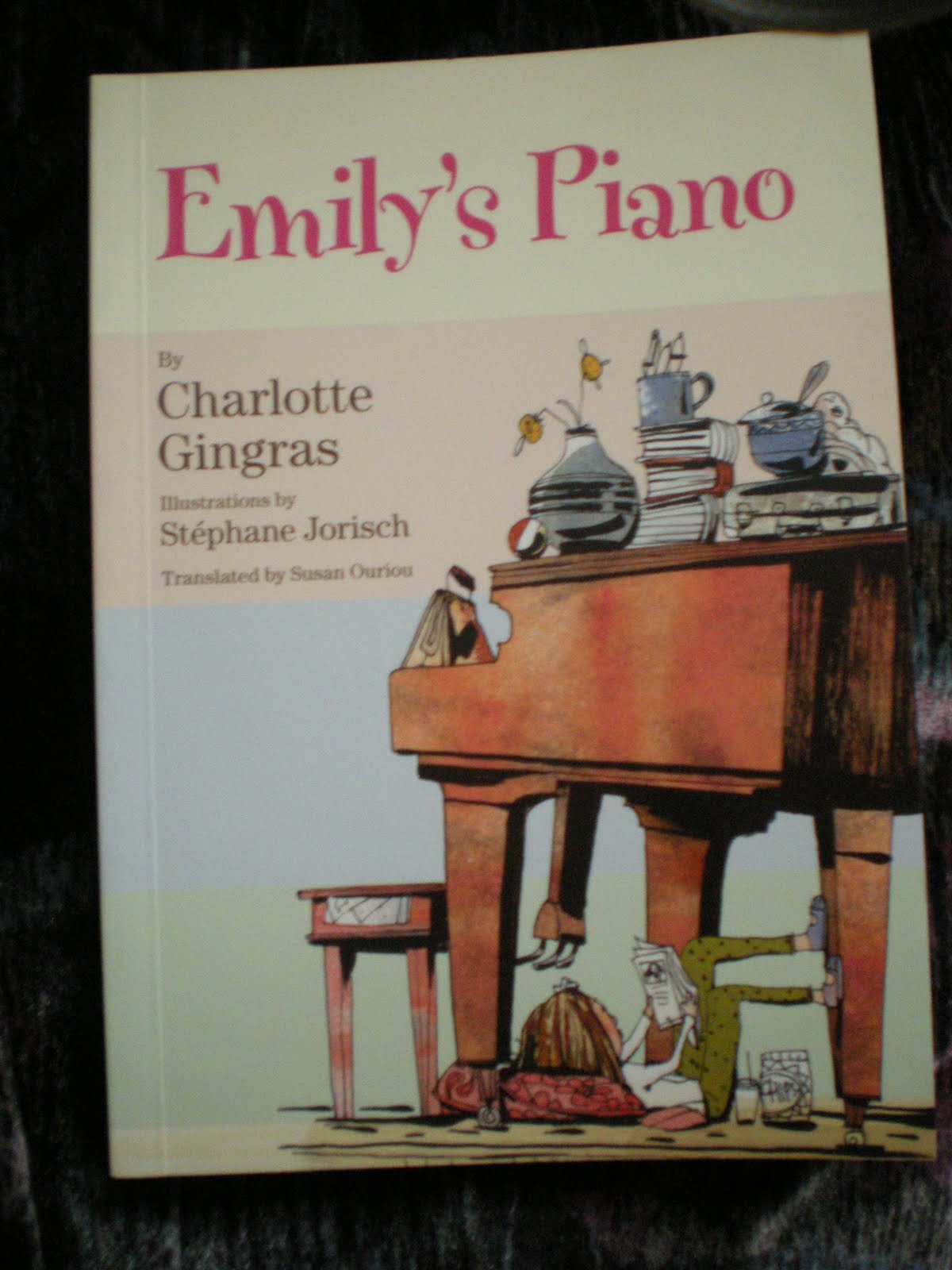
-Stephane Jorisch
-Susan Mitchell
-Janice Nadeau
-Isabelle Arsenault
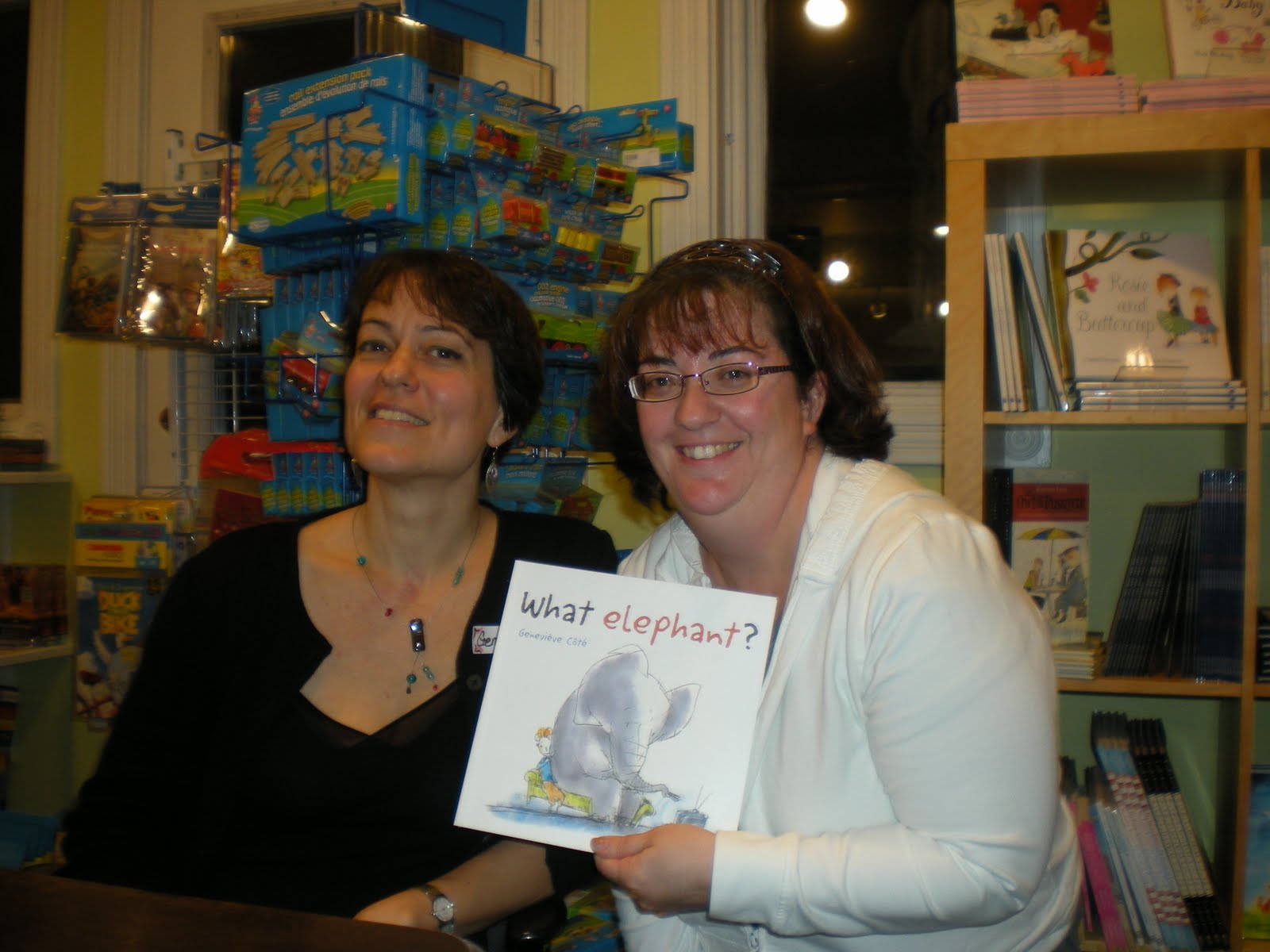
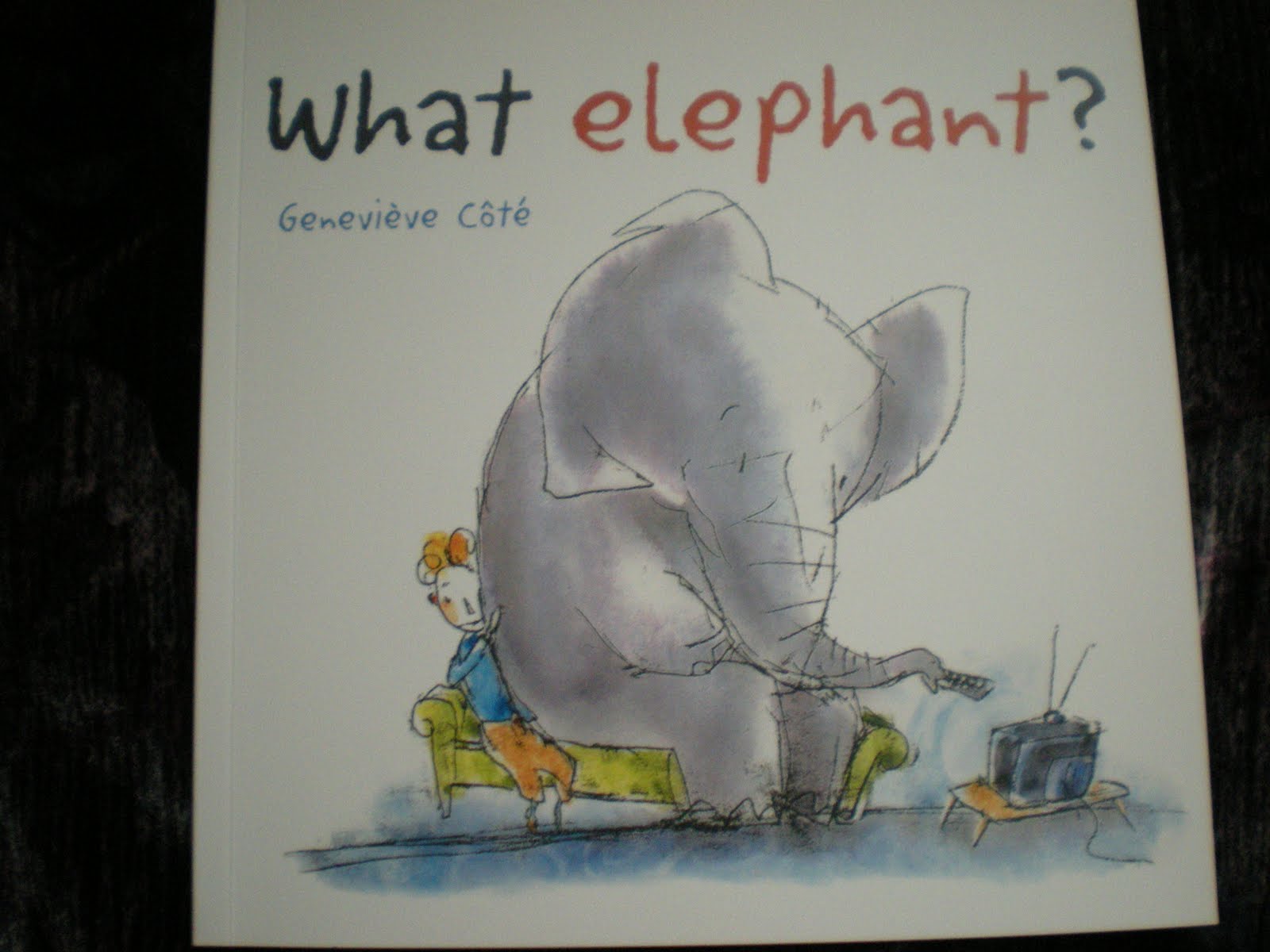
-Genevieve Cote
| Genevieve Cote and me with her book What Elephant? |
I am sure I am forgetting some people and if I am I apologize. Please let me know and I will add you to the list. I would have taken more photos but for some reason it felt a little awkward considering I was the only non librarian there.
So here is some of the books I bought and had signed:
| This was signed to Michael from Susan Mitchell. |
| Genevieve did this illustration for Michael and signed it to him. Its too cute isn’t it? |
| Stephane signed and drew this piano illustration for Michael. |
So after buying the above stuff I spotted some bookmarks that you could take so I grabbed some of them to use as future give aways later on. I think they are all great and I see quite a few for books I have never heard of. I have to admit I absolutely love the book mark that is on your far left of the little girl.
Thanks Babar Books for hosting this awesome event and thanks to Kids Can Press for coming to introduce us to some local authors and illustrators.
My next event will be Lori Weber’s launch party for her newest ya book Yellow Mini at Babar Books next Thursday night.
If you are reading this on a blog or website other than Cindy’s Love Of Books or via a feedreader, this content has been stolen and used without permission.
(Author Interview) Kristine Grayson
I have been lucky enough to read both of Kristine’s latest books.
Wickedly Charming came out in April of 2011 and Utterly Charming just came out this month. I also found out that Sourcebooks is going to reissue two of her books coming out next year in 2012. Both were fantastic books that I loved reading and if you like reading a little romance with a modern day twist on classic fairy tales then this is the author and books for you.
So without further hesitation here is my interview with Kristine Grayson.
Cindy: What is your favorite fairy tale and why?
KG: My favorite fairy tale is the Little Mermaid. I love the story in the original—with the sad ending and all. I have no idea why. I have always loved the story, however, and might use it someday for one of my tales.
Cindy: The Little Mermaid is one of my favorites too. Who is your favorite Prince Charming and why?
KG: I should say that it’s Sleeping Beauty’s Prince Charming, since this interview celebrates the release of Utterly Charming, which features this particular Prince Charming. But honestly, my favorite is Cinderella’s Prince Charming. Even in the fairy tale, the man is a romantic. He searches for the woman he loves and he doesn’t care who she is or how she was raised. He doesn’t secretly discover that she was a princess or something like that. He just loves her for who she is. I made him the hero of Wickedly Charming, and a book lover, because I think that simply adds to the romance.
Cindy: For me when I think about Prince Charming the first one that always comes to mind its Cinderella’s Prince Charming and for the reason’s you have mentioned. Why did you decide to give the classic fairy tale a modern twist?
KG: Sadly, when I write, I don’t decide anything. The stories just happen. I think I’ve always had a twisted view of fairy tales. I wanted to know why instead of the lessons being imparted. So it’s a reflection of my contrary nature, I guess.
Cindy: Are you working on anything new?
KG: I just finished the next in the Charming series. This one, Charming Blue, features Bluebeard as my hero—yes, that Bluebeard (you see him in cameo in Wickedly Charming)—and it’s set in Los Angeles. It’s…not what you’d expect, which I guess is par for the course for me.
Cindy: Will you be writing any more fairy tale books?
KG: Oh, yes. You can’t stop this imagination. Not only am I doing the Charming series for Sourcebooks, but sometime in 2012, WMG Publishing will publish the first in the Once Upon A Crime mysteries, set in the same fairy tale universe, only with mysteries as the focus instead of a romance. Plus I’ve already done one story about Grace and Imperia, the daughters of Prince Charming and Cinderella, and I plan to do more.
Thanks for asking!
Oh Kristine I can’t wait to read your other books. They sound really good and I am so happy that Sourcebooks is going to be reissuing yout Charming series. I absolutely love them.
About the author:
Kristine Grayson has written seven paranormal romances. Her first, Utterly Charming, received the Romantic Times Reviewer’s Choice Award. She also writes science fiction and fantasy under her real name, Kristine Kathryn Rusch, and mystery as Kris Nelscott. She’s married to her very own Prince Charming, writer Dean Wesley Smith, and lives with him on the beautiful Oregon Coast.
You can check out the Kristine Grayson’s blog.
Thanks so much to Sourcebooks for arranging this interview and making it possible and thanks so much to Kristine for taking the time out of her busy schedule to do this interview for me. I love when I get the chance to interview authors of books I love so much.
If you are reading this on a blog or website other than Cindy’s Love Of Books or via a feedreader, this content has been stolen and used without permission.